Tree Removal Service in Bozeman
Tree removal service in Bozeman and the Gallatin Valley. Safe takedowns of dead, leaning, or storm-damaged trees on variable mountain soils.
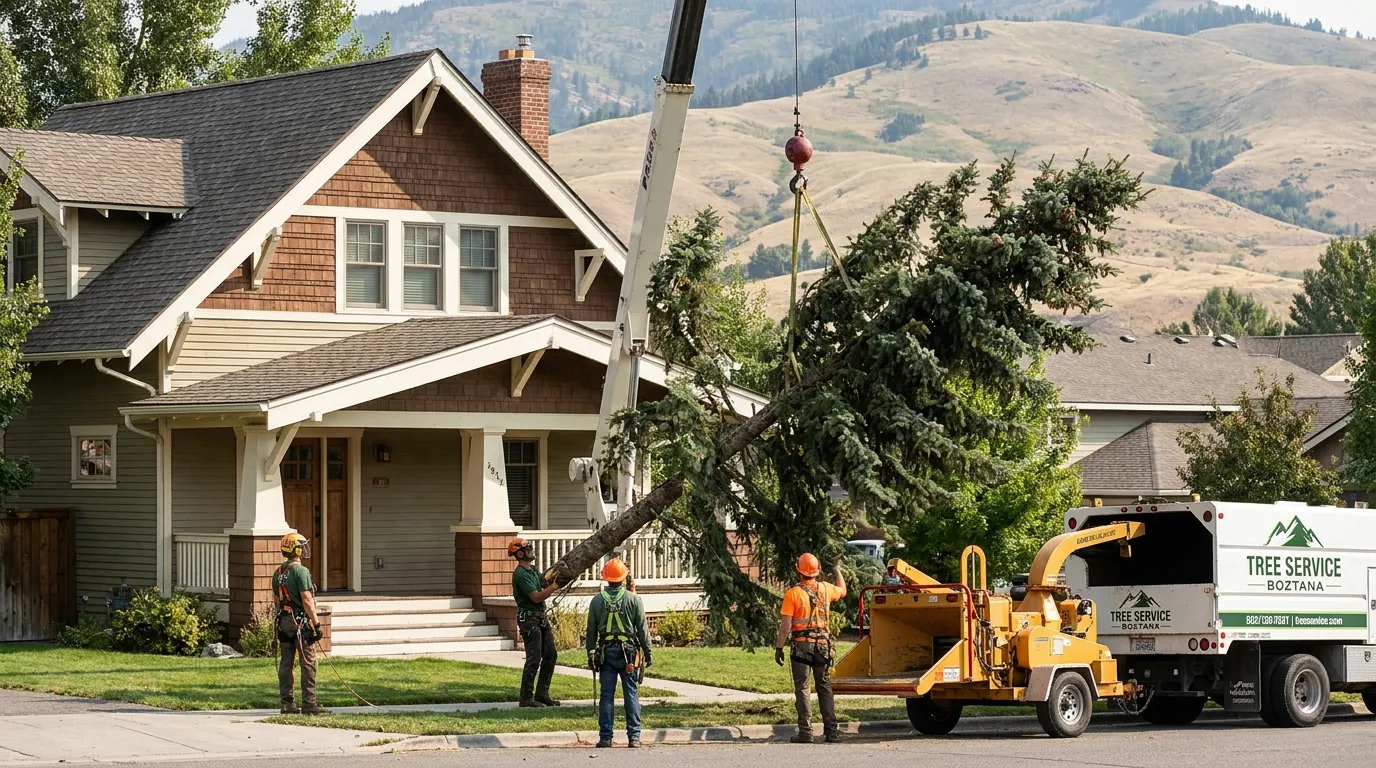
When a tree has to come down
A tree removal service is the work of taking a whole tree down safely, in a controlled sequence, and clearing the wood and debris afterward. In Bozeman, most calls come after a hard winter or a windstorm off the Bridgers, when a spruce has died back, a cottonwood has cracked at a limb union, or a lodgepole is leaning toward a roof or fence line. If you are searching for a tree service near me or the tree removal company closest to me, it usually means something has already changed — the tree looks different than it did last season, or it has started shedding limbs.
The warning signs that a tree needs removal rather than trimming are fairly consistent here. Watch for large dead sections in the crown, bark falling away in sheets, mushroom conks at the base, a sudden lean after a freeze-thaw cycle, or roots that have heaved out of the ground on the windward side. Bozeman's wide temperature swings and hard freezes stress trees that were already weak, so a tree that limped through a couple of mild years can fail quickly after one severe winter.
Not every struggling tree needs to come down. Sometimes the right answer is pruning or cabling, which is why we look at each tree in place before recommending removal. If the structure can be saved, tree removal repair may be the better path, and after a removal many homeowners plan a replacement planting so the yard is not left bare.
How a removal is done
Every job is planned around the tree's condition, what surrounds it, and the ground it stands on.
-
Assess the tree and the site
We look at lean, decay, root condition, and what is under and around the tree — house, power lines, fences, driveways. On a tight Bozeman city lot the approach is very different from an open acreage out toward Four Corners.
-
Choose a removal method
A tree with clear space around it can sometimes be felled in one piece. Most residential removals are done in sections, with limbs and the trunk lowered by rope so nothing lands where it should not.
-
Take the tree down in stages
Working from the top down, we remove limbs, then trunk sections, controlling each piece. Cuts are made with the wood's condition in mind, because frozen or rotted wood behaves differently than sound, seasoned wood.
-
Handle the stump
The stump can be cut low, ground below grade, or left depending on what you want the space for. Grinding is common when you plan to replant or reseed the area.
-
Clean up and haul
We clear brush, chip what makes sense, and haul off or stack wood as agreed. You are left with a usable, safe space rather than a debris pile.
Concerned about a tree?
Tell us what you are seeing — the lean, the dead limbs, the crack — and where the tree sits on your property. We will help you decide whether it needs to come down.
Serving Bozeman, Four Corners, Livingston, and the surrounding Gallatin and Paradise valleys.
Frequently asked questions
How do I know if my tree needs removal or just trimming?
If the trunk is sound and only some branches are dead or crossing, trimming or repair pruning is often enough. Removal is the answer when the trunk is decayed, the tree is dead, or it leans dangerously toward a structure. We assess each tree in place before recommending either path.
Is winter a bad time to remove a tree in Bozeman?
Winter can actually be a good time. Frozen ground protects lawns from heavy equipment, and a leafless crown is easier to read and lower in sections. The main considerations are access on snowy lots and how frozen wood behaves during cutting, both of which we plan for.
What happens to the wood and debris?
We can chip brush on site, haul everything away, or stack usable wood for you to season and burn. Just tell us your preference when we plan the job so the cleanup matches what you want left behind.
Do you remove trees near power lines or houses?
We remove trees in tight spots by taking them down in controlled sections and lowering pieces by rope rather than dropping them. If a tree is touching an energized line, that portion has to be coordinated with the utility before work begins.